


Consultation hotline
The working process and function of water softening equipment
Release time:
2026-02-26 17:10
In our daily lives, we often see scale forming on the inner walls of kettles after prolonged use. What causes this? It turns out the water we drink contains many inorganic salts, such as calcium and magnesium salts.
These salts are invisible to the naked eye in water at room temperature. However, when the water is heated to a boil, a large amount of calcium and magnesium salts precipitate out in the form of carbonates, forming scale that sticks to the walls of the container. We typically use the hardness index to indicate the amount of calcium and magnesium ions in water. 1 degree of hardness corresponds to 10 milligrams of calcium oxide per liter of water. Water below 8 degrees is called soft water; water above 17 degrees is called hard water; and water between 8 and 17 degrees is called moderately hard water. Rainwater, snowmelt, river water, and stream water are generally soft water, while spring water, deep well water, and seawater are hard water.
The Working Process of Water Softening Equipment:
There are five main stages: Backwash, Brine Suction, Slow Rinse (Displacement), and Fast Rinse. The processes for different softeners are quite similar, though some additional steps might be included based on specific process or control needs. Essentially, all sodium ion exchange water softening equipment is designed around these five processes (fully automatic softeners often include an enhanced brine refill process).
-
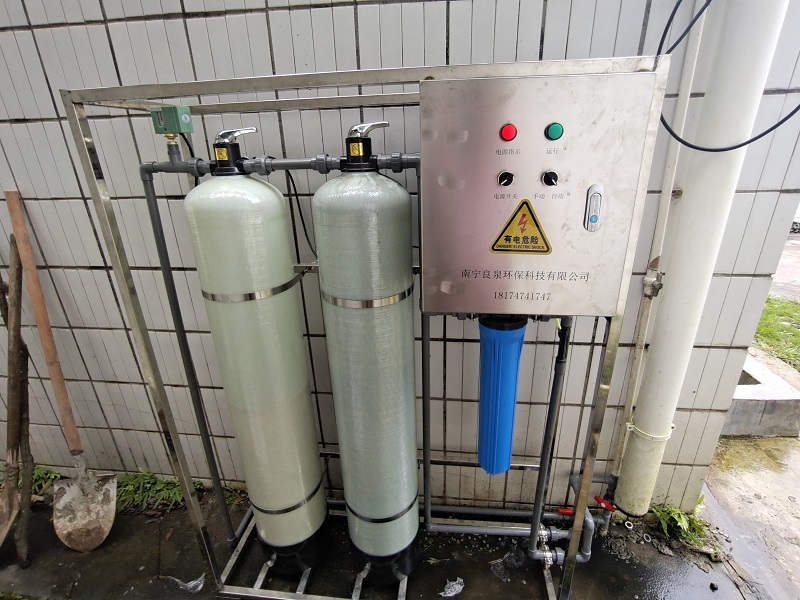
Backwash: After the Nanning water purification equipment has run for a certain period, a significant amount of raw water brings impurities that get trapped on top of the resin bed. Removing these impurities allows the ion exchange resin to be fully exposed for better subsequent performance. The backwash process involves flushing water from the bottom of the resin tank, which carries the impurities trapped at the top out through the top outlet. This process typically takes about 5-15 minutes.
-
Brine Suction: This is the process of pumping brine into the resin tank. Traditional equipment uses a brine pump. Fully automatic water treatment equipment uses a built-in ejector to draw in the brine (as long as the inlet water has sufficient pressure). In practice, having the brine flow slowly through the resin results in better regeneration than simply soaking the resin in brine. Therefore, water softeners are regenerated by allowing the brine to flow slowly through the resin. This process usually takes about 30 minutes; the actual time depends on the amount of salt used.
-
Slow Rinse (Displacement): After the brine has flowed through the resin, the process of using raw water at the same slow flow rate to rinse the remaining salt from the resin is called slow rinse. This is because many functional groups on the resin still have residual calcium and magnesium ions. During this rinse process, calcium and magnesium ions are exchanged for sodium ions. Based on practical experience, this is the main regeneration process, which is why many people call it "displacement." This process typically takes about the same time as brine suction, around 30 minutes.
-
Fast Rinse: To completely rinse out all remaining salt, the resin must be rinsed with raw water at a flow rate close to the actual service flow rate. The final effluent from this process must be softened water that meets quality standards. Under normal circumstances, the fast rinse process takes 5-15 minutes.
The Function of Water Softening Equipment
-
Using water softening equipment saves a significant amount of fuel. For example, when scale forms in a boiler, a 1-millimeter thick layer of scale in a boiler operating at 1.4 MPa can lead to an 8% loss in fuel.
-
Water softening equipment improves thermal efficiency and prevents reduced output. When scale forms on the heating surface of a boiler, the heat from the fire side cannot be transferred quickly to the water side, reducing the boiler's output. If a boiler becomes scaled due to inadequate water treatment, its evaporation capacity could drop by one-third, potentially causing automatic production lines to shut down due to insufficient steam supply.
-
The use of water softening equipment reduces boiler maintenance needs. Scale on boiler plates or pipes is very difficult to remove, especially when it leads to problems like leaks, cracks, breakage, deformation, and corrosion.
More news


Contact Us
Guangxi Jonline Technology Co., Ltd.
Company Address: No. 14, 1st Floor, Factory No. 2, Phase I, ASEAN International Smart Park, No. 43 Anji Avenue, Nanning City
Factory Address: No. 14, 1st Floor, Building No. 2, ASEAN International Smart Park (Phase I), No. 43 Anji Avenue, Nanning City
Phone:18249982787
Email:876089222@qq.com
WeChat Official Account