


Consultation hotline
The complete operation process of water softening equipment
Release time:
2026-02-26 17:12
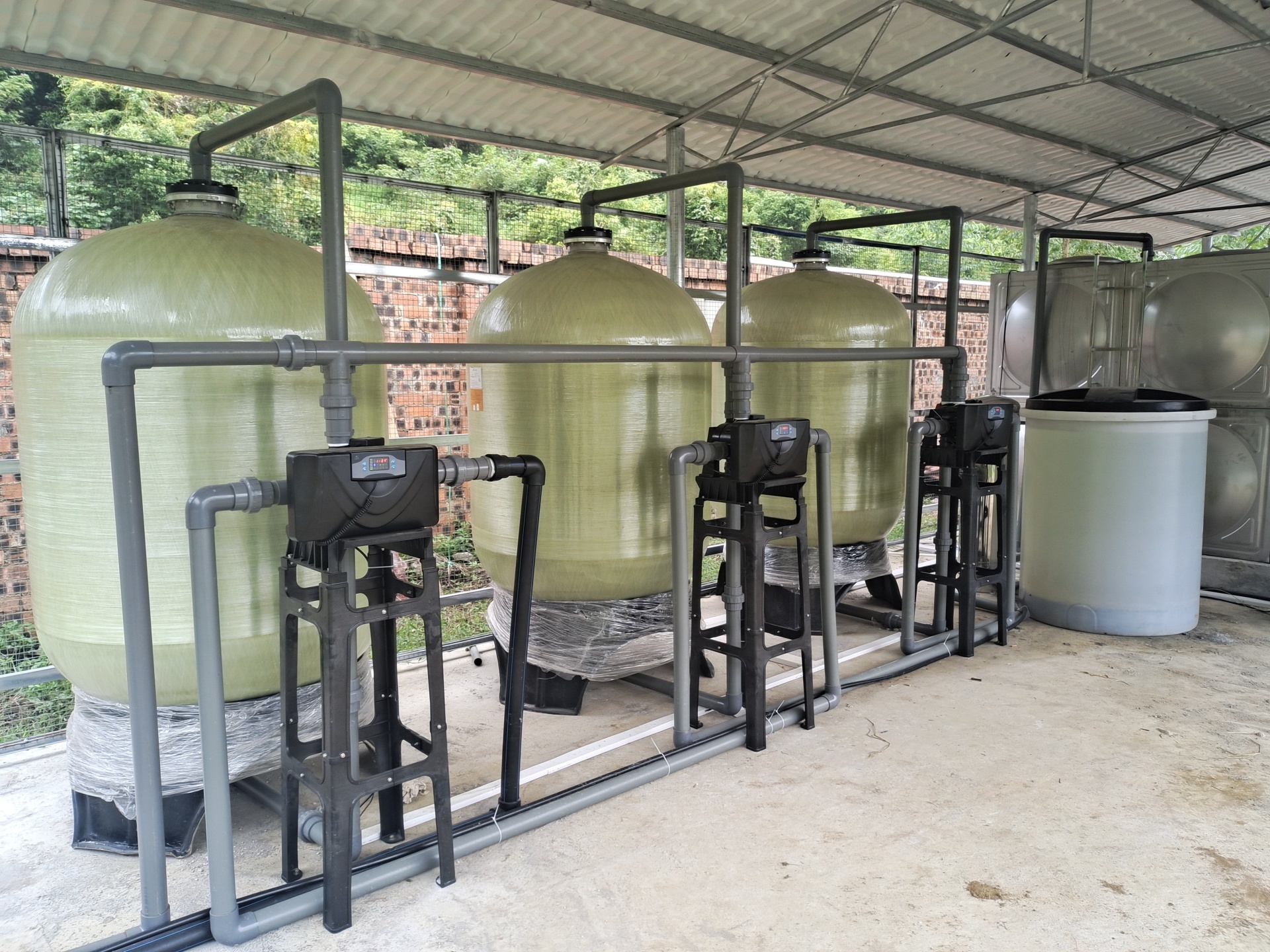
The complete operation process of water softening equipment generally consists of the following steps cyclically: Backwash, Brine Suction (Regeneration), Slow Rinse (Displacement), and Fast Rinse — five processes in total. The procedures for different water softeners are very similar, though there may be some additional steps depending on specific circumstances or control needs. Any water softening equipment based on sodium ion exchange is developed from these five basic processes.
Automatic Water Softener Operating Program:
A. Operation (Service Flow)
Raw water, under appropriate pressure (0.2-0.6 MPa) and flow rate, enters the valve body and then passes into the vessel (resin tank) filled with ion exchange resin. The Na⁺ contained in the resin exchanges with the cations (Ca²⁺, Mg²⁺, Fe²⁺, etc.) in the water. This ensures that the content of Ca²⁺ and Mg²⁺ ions in the water leaving the vessel meets the required target, achieving the softening of hard water.
B. Backwash
After the resin is exhausted and before regeneration begins, water is used to backwash the bed from the bottom up. Backwashing has two purposes: first, it loosens the compacted resin bed from the service cycle, allowing for better contact between the resin particles and the regenerant solution; second, it removes suspended solids accumulated on the resin surface and any broken resin particles, flushing them out with the backwash water. This prevents the flow resistance within the exchanger from increasing over time.
C. Regeneration (Brine Suction)
The regenerant salt solution, at an appropriate concentration and flow rate, flows through the exhausted resin layer to restore its original exchange capacity.
D. Displacement (Slow Rinse)
After the regenerant has been completely introduced, some unreacted regenerant solution remains in the exchanger. Clean water is used to rinse the bed at a flow rate less than or equal to the regenerant flow rate (slow rinse). This allows for the efficient utilization of the regenerant's capacity and reduces the load for the subsequent fast rinse.
E. Fast Rinse (Fast Rinse)
The purpose is to remove the residual regeneration waste liquid from the resin layer. It is typically carried out at the normal service flow rate until the effluent water quality meets the required standards.
F. Refill Water for Brine Tank
Water is introduced into the brine tank to prepare the salt solution for the next regeneration cycle. The amount of water corresponds to the amount of salt needed for one regeneration.
The above outlines the complete operation process of water softening equipment.
Previous page
More news


Contact Us
Guangxi Jonline Technology Co., Ltd.
Company Address: No. 14, 1st Floor, Factory No. 2, Phase I, ASEAN International Smart Park, No. 43 Anji Avenue, Nanning City
Factory Address: No. 14, 1st Floor, Building No. 2, ASEAN International Smart Park (Phase I), No. 43 Anji Avenue, Nanning City
Phone:18249982787
Email:876089222@qq.com
WeChat Official Account